1929
Location
Race Details
1929 Schneider Cup Course
Venue and start/finish. The 1929 Schneider Trophy race was flown over the Solent between the Isle of Wight and the Hampshire coast. The start and finish line was near Ryde Pier on the Isle of Wight; the event was widely associated with Calshot, where the British High Speed Flight was based and trained. Some summaries call it the Calshot or Cowes race, while others identify the course as Spithead or the Solent; these refer to the same race area, not to a course located solely at the air station.
Shape and route. A detailed race history describes the 1929 loop as a quadrilateral about 30 miles long, with the start/finish line just off Ryde Pier and pylon turns off Seaview, off Hayling Island, off Southsea Pier, and off West Cowes. The turn pylons were mounted on vessels, including destroyers at some points. This course geometry differed from the triangular circuits used in many earlier Schneider races. The map follows the reported landmark sequence as a geographic reconstruction; it is not a precision survey, and exact buoy coordinates have not been confirmed.
Lap count and distance. The final race-result record and several later histories give seven laps of a 50 km (about 31 statute miles) circuit, or 350 km (about 217.5 statute miles) in total. A detailed history instead describes the route as a quadrilateral about 30 miles (48 km) long, consistent with normal rounding to 50 km. There is also a pre-race newspaper report describing a planned 60 km course to be flown five times (300 km); this likely records an earlier plan that did not match the final result. A 1929 U.S. Air Service retrospective says seven laps but prints 750 km, which conflicts with the result table and the winners' recorded times and speeds and appears to be a reporting or transcription error.
Direction and course rules. Later accounts describe the turns as left-handed. Pylon vessels marked the turning points, and competitors had to round each marker correctly: Flying Officer Atcherley was disqualified after cutting inside or missing a pylon, despite completing the course. Sources disagree about which pylon was involved. The contest was for seaplanes and the course was entirely over water. The race programme and chronologies give 6–7 September as the event window; the actual Trophy race took place on 7 September 1929.
Sources: AirRace, detailed Schneider Trophy results; AirRace, race summary: seven laps of 50 km; U.S. Air Service Newsletter (1929), race report and lap-speed table; Star (Christchurch), 7 September 1929, pre-race Admiralty course plan; 1929 course reconstruction based on the 1929 Flight course map; Science Museum Library and Archives catalogue, Admiralty 1929 course plans.

The course length and map’s red line is a visual reconstruction, not a claim to the exact historical buoy layout.
The Winner
(1,900 hp)
328.63 mph

Click the Icons above to be redirected to Wikipedia Information on that subject
The Supermarine S.6 (later designated the S.6A) is a 1920s British single-engined single-seat racing seaplane built by Supermarine and designed by its chief designer, R.J. Mitchell, who refined the earlier Supermarine S.5 to produce a larger, more powerful aircraft.
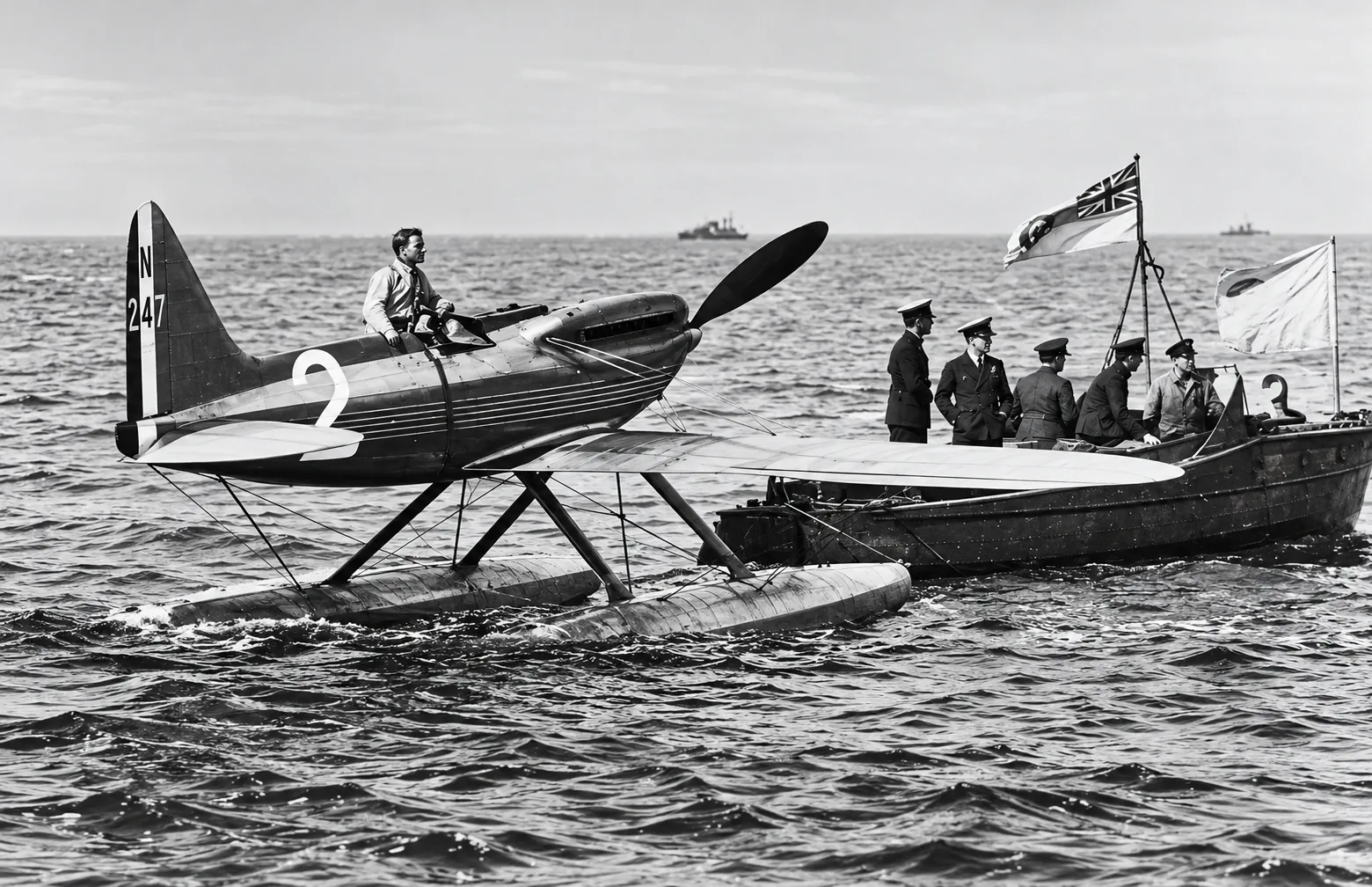
Two aircraft, N247 and N248, were built to participate in the 1929 Schneider Trophy contest. Rolls-Royce produced the R engine for the new all-metal aircraft. The engine's initial issues—such as the short time between overhauls and the heat generated when the engine power was increased to 1,900 hp (1,400 kW)—were resolved within a few months before the aircraft were completed at Supermarine’s works at Woolston, Southampton.




Race setting and competitors
The eleventh Schneider Trophy contest was held over the Solent on 7 September 1929. Great Britain and Italy were the only nations with starters. France and the United States had withdrawn their planned entries; Germany's proposed participation did not produce a starter. The race therefore became a direct contest between Britain's Royal Air Force High Speed Flight and the Italian team. It was held in fine conditions before a very large crowd along the Solent shores.
Great Britain: Flying Officer Henry Richard Danvers (Dick) Waghorn flew the new Supermarine S.6 N247, powered by a Rolls-Royce R engine rated at about 1,900 hp. Flying Officer Richard L. R. Atcherley flew the second S.6, N248. Flight Lieutenant David D'Arcy Greig flew the older Supermarine S.5 N219, with a Napier Lion engine. The S.6 was an all-metal, twin-float monoplane and a major redesign from the S.5. Two Gloster VI racers were withdrawn before the race and did not start.
Italy: Warrant Officer Tommaso (often rendered Tomasso) Dal Molin flew the Macchi M.52R, a development of the 1927 M.52 using a Fiat engine. Lieutenants Remo Cadringher and Giovanni Monti flew Macchi M.67 floatplane monoplanes powered by Isotta-Fraschini engines. The M.67s were fast but suffered serious engine and exhaust-system problems.
Race events and results
Waghorn completed the seven-lap course in 39 minutes 42.8 seconds, averaging 328.63 mph (528.88 km/h), a Schneider Trophy race record. Dal Molin finished second in 45:54.4 at about 284.2 mph (457.4 km/h). Greig finished third in 46:15.2 at 282.11 mph (454.0 km/h). Waghorn’s performance showed the S.6 and Rolls-Royce R engine’s substantial advantage over the earlier generation of racers.
Atcherley completed the course in about 40:01.5 at a reported 325.54 mph, but was disqualified for cutting inside or failing to round one of the pylons. His lap speed of about 332 mph was the fastest reported in the race, and he set 50 km and 100 km closed-circuit records. Sources differ on which pylon he missed or cut inside.
Neither M.67 finished. Cadringher’s cockpit filled with exhaust fumes, impairing his vision and forcing him to land after an early lap. Monti retired after a broken water pipe sprayed hot water and scalded him. Dal Molin, flying the older M.52R, was the only Italian to complete all seven laps. The contemporary U.S. Air Service account says the M.67 retirements occurred on the second lap; some shorter reports say they were forced down after the first lap, likely describing the same early-race failures.
Recorded results:
| Result | Pilot | Aircraft | Time / average speed |
|---|---|---|---|
| 1 | Henry R. D. Waghorn (Great Britain) | Supermarine S.6 N247, no. 2 | 39:42.8; 328.63 mph |
| 2 | Tommaso Dal Molin (Italy) | Macchi M.52R, no. 4 | 45:54.4; about 284.2 mph |
| 3 | D’Arcy Greig (Great Britain) | Supermarine S.5 N219, no. 5 | 46:15.2; 282.11 mph |
| Disqualified, course completed | Richard L. R. Atcherley (Great Britain) | Supermarine S.6 N248 | About 40:01.5; 325.54 mph |
| Retired | Remo Cadringher (Italy) | Macchi M.67 | Exhaust fumes / visibility trouble |
| Retired | Giovanni Monti (Italy) | Macchi M.67 | Broken water pipe; scalded |
Winner and significance
Waghorn’s victory gave Britain its second consecutive Schneider Trophy win after Sidney Webster’s 1927 success. Britain won again in 1931 and therefore kept the Trophy permanently. The contest was also a major demonstration of the Rolls-Royce R engine and the S.6’s advanced streamlined metal construction. The high-speed technology developed for the Schneider racers informed British aircraft and engine development in the years that followed.
Historical uncertainties. The most consistent final-race account is seven laps of 50 km (350 km), but a pre-race report printed a 60 km circuit flown five times, and a U.S. Air Service retrospective gives an incompatible 750 km total. The latter cannot agree with the recorded winning time and speed. Dal Molin's average is rounded differently across sources (284.11 or 284.2 mph). Atcherley's exact disqualification pylon varies by account. Source spellings of Dal Molin's first name and the M.52 variant also vary. The map route and marker locations are approximate reconstructions.
Sources: AirRace, Schneider Trophy results; AirRace, race summary; U.S. Air Service Newsletter (1929), official retrospective and race data; RAF Museum, 1929 aviation timeline; Italian Air Force, Macchi M.67 history; Western Star, 10 September 1929, contemporary race results and incidents; Otago Daily Times, 10 September 1929, contemporary report; Atcherley Archive, images and report of the pylon disqualification.