1919
Location

Race Details
1919 Schneider Cup Course
The 1919 Schneider Trophy race was scheduled for Bournemouth on 10 September 1919. The Royal Aero Club course was a triangular sea circuit of approximately 20 miles per lap, flown for 10 laps, a nominal race distance of about 200 miles. An article in Flight published before the race described the route as Bournemouth to Swanage, then Christchurch, and back to Bournemouth, with an approximately 20-mile lap. Later local histories give the turning geography more specifically: from Bournemouth Pier west to Durlston Head, across Poole Bay to Hengistbury Head, and back toward the Boscombe finish. AirRace summarizes it as ten laps of a 37-km course. These figures are broadly compatible if “miles” is read as nautical miles (20 nmi ≈ 37 km), but historical summaries do not always state the unit clearly. Sources: Flight, 28 August 1919, course announcement reproduced in the aircraft archive, Dorset Life’s local course history, and AirRace’s Schneider history.
The important geographic points were the start area off Bournemouth Pier, the offshore turn near Durlston Head/Swanage, and the eastern turn near Hengistbury Head, with the finish reported near Boscombe Pier. The turn markers were boats, not permanent buoys. The map plots these as approximate points and shows a closed triangular lap for orientation. Exact coordinates, the precise line separating the Bournemouth start and Boscombe finish, and the full historical geometry have not been independently verified. The UK National Archives catalogue records a 1919 Schneider course map in its collection, but its catalogue description does not expose the marker coordinates; see the Science Museum Library and Archives catalogue.
The course was meant to be flown in repeated timed laps, with water operation built into the contest rules. Competitors had to make two mandatory water touch-downs during the race; accounts describe these as required alightings on the first lap. The long course and water stops were intended to test the practical handling and reliability of seaplanes as well as speed. However, the dense sea fog hid the distant marker craft, especially around Swanage, and the race proceeded without all turns being visible to pilots or officials. That visibility failure made correct navigation impossible to verify and ultimately invalidated the result. See Kingston Aviation’s account and HydroRetro’s race history.
The map uses the widely repeated 10-lap, roughly 37-km circuit and the local Bournemouth–Durlston–Hengistbury route description. It is a satellite-style visual reconstruction, not a precise historical survey. In particular, the positions of the official Swanage mark-boat and the reserve boat that confused Guido Jannello remain approximate in the image; the sources agree that the boats were confused but do not establish exact 1919 coordinates.

The course length and map’s red line is a visual reconstruction, not a claim to the exact historical buoy layout.
The Winner
All racers either were disqualified or retired there was no winner

Click the Icons above to be redirected to Wikipedia Information on that subject
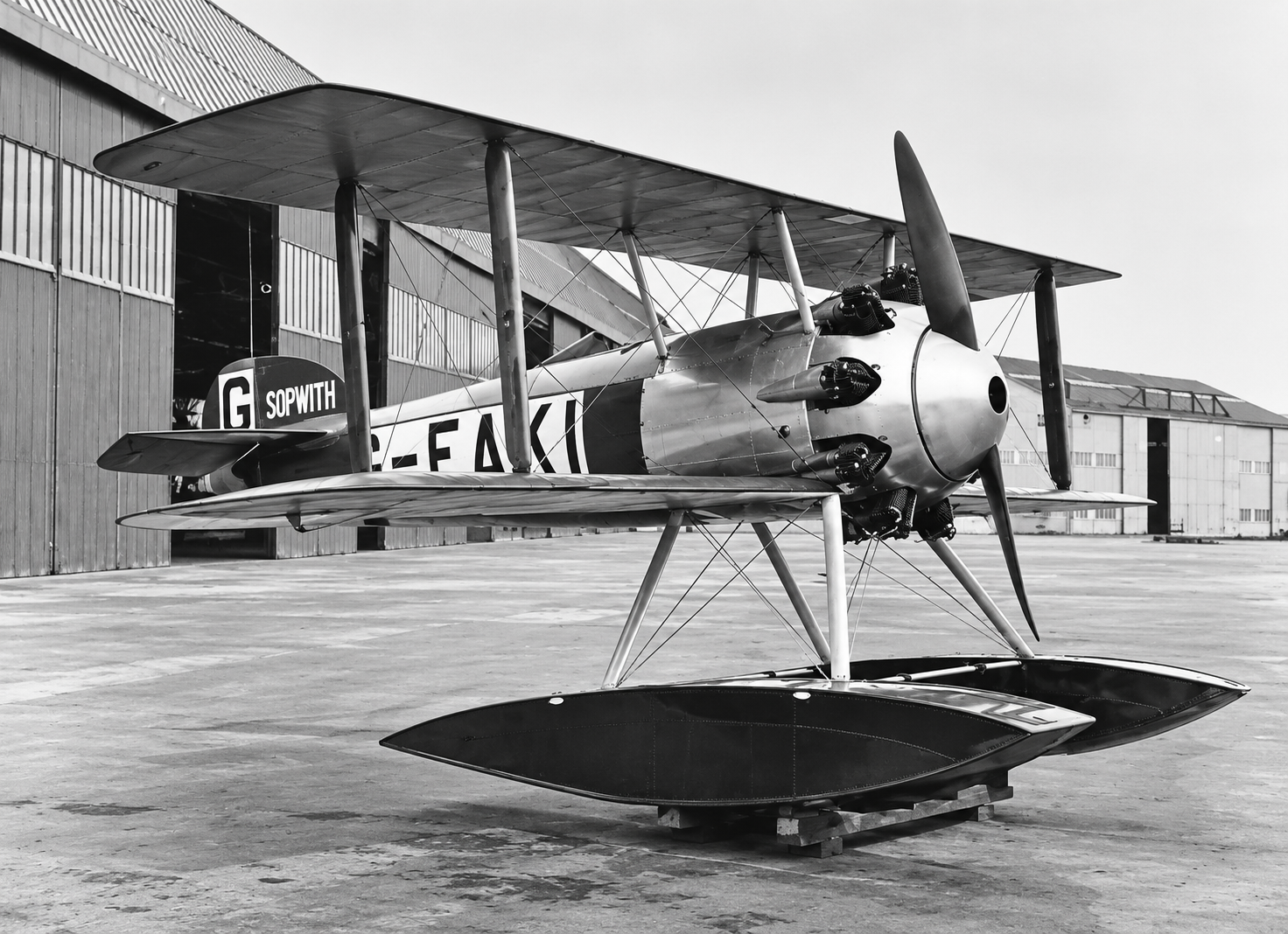
Race was declared No Contest. Despite this, Italy was designated as the host country for the next race. Here are the aircraft that took part




What happened on the circuit
The 1919 contest at Bournemouth was the first Schneider Trophy race after the First World War. Teams from Great Britain, France and Italy prepared entries. The British field comprised Vincent Nicholl in a Fairey III, Harry Hawker in a Sopwith Schneider, and Squadron Leader Basil D. Hobbs in the Supermarine Sea Lion I; an Avro 539A flown by Captain Hamersley served as a reserve and was eliminated or did not start, depending on the account. France’s Sadi Lecointe and Casale arrived with a SPAD and a Nieuport, but damaged or waterlogged floats prevented them from starting. Italy entered Guido Jannello (also rendered Janello or Gianello in later sources) in a Savoia S.13 flying boat.
Results and significance:
| Result | Pilot | Aircraft | Time / average speed |
|---|---|---|---|
| Disqualified; race declared no contest | Guido Janello (Italy; also spelled Jannello or Gianello) | Savoia S.13, no. 7 (also identified as S.13bis) | No official time or speed accepted; reported to have completed the course but was ruled to have missed the Swanage turning mark |
| Retired | Vincent Nicholl (Great Britain) | Fairey III | Retired on the first lap; no official time |
| Retired | Harry Hawker (Great Britain) | Sopwith Schneider | Retired on the first lap; no official time |
| Retired | Basil D. Hobbs (Great Britain) | Supermarine Sea Lion I | Retired on the first lap; aircraft damaged and sank after landing; no official time |
| Did not start | Casale (France) | Nieuport seaplane; subtype varies in accounts | Float trouble prevented the French entries from starting; no time |
| Did not start | Sadi Lecointe (France) | SPAD seaplane; subtype varies in accounts | Float trouble prevented the French entries from starting; no time |
Notes on the record. The 1919 contest at Bournemouth was officially declared no contest; there was no trophy winner. Janello was the only pilot reported to have completed the nominal race distance, but referees ruled that he had not rounded the official Swanage mark correctly. In dense fog, Janello said that a non-official boat had misled him. The official ruling was disqualification, not a win. HydroRetro: 1919 race history and results; Kingston Aviation: 1919 race-day account; Royal Aeronautical Society: Dorset aviation history.
Uncertainties and variations. Sources spell the Italian pilot’s name as Janello, Jannello, or Gianello, and describe his aircraft as either the Savoia S.13 or S.13bis. Some retrospective accounts quote an average near 204 km/h, but no accepted official time or speed survives; the race was voided after the buoy dispute. Accounts differ over course chronology and the French aircraft variants. HydroRetro lists the three British aircraft as giving up on the first lap and the French pair as unable to start; other reconstructions provide further detail but cannot establish the exact visibility, marker-boat positions, or flight path in the fog. The Avro flown by Captain Hamersley was a British reserve/elimination entry, rather than a race finisher. Associazione Arma Aeronautica: Schneider Trophy history; HistoryNet: Schneider Trophy race; Dorset Life: an early Bournemouth air festival.
Race day brought thick sea fog over the course. The start, initially expected around 2:30 p.m., was delayed while officials waited for visibility to improve; sources disagree about the eventual starting time, with one local reconstruction placing the first start at about 4:30 p.m. and AirRace giving a later delay. Once the race began, the marker craft at the distant turns were hard or impossible to see. Nicholl turned back, Hawker failed to locate the Swanage mark-boat and damaged a float on landing, and Hobbs’s Sea Lion was damaged after alighting in the fog and sank near Boscombe. The event had poor logistical coordination: accounts report inadequate communication with pilots and limited support facilities at the public beach.
Jannello’s Savoia was the only aircraft to keep flying long enough to appear to complete the required distance. The central dispute was at the Swanage turn: officials said Jannello had not rounded the official marker boat. Jannello and the Italian team maintained that fog and a similar-looking reserve boat in Studland Bay misled him; Kingston Aviation recounts that the spare boat was in Studland Bay while the official mark-boat was at Swanage. Jannello’s team also alleged that officials had failed to provide clear course and weather information. The exact boat positions and what Jannello could see cannot be reconstructed with certainty from the sources consulted.
The referees disqualified the Italian entry, and the race was declared no contest. Therefore, although Jannello was the only reported finisher, he was not the official winner and Italy did not receive a 1919 trophy victory. The Royal Aero Club and the Fédération Aéronautique Internationale subsequently assigned Italy the right to host the next contest, which was held at Venice in 1920. Some retrospective accounts loosely describe Italy as having “won” in 1919, but official summaries and specialist histories state that no award was made.
No accepted finishing time or speed exists because the course was disputed. Figures sometimes quoted for Jannello—including about 124.9 mph in a 1925 U.S. Air Service retrospective and around 204 km/h in an Italian association history—should not be treated as official race records. Kingston Aviation says the team questioned his lap times because they appeared too fast for a full circuit and sent him for an additional lap to ensure the nominal distance; the alleged shortcut at the Swanage turn further undermines any average-speed calculation. The reliable result is the ruling: disqualified; contest void; no winner declared.
Sources: HydroRetro’s 1919 results and account, Kingston Aviation’s detailed race-day reconstruction, Dorset Life’s local history, the Royal Aeronautical Society’s Dorset aviation history, the U.S. Air Service Newsletter retrospective, and the Science Museum.