1922
Location
Race Details
1922 Schneider Cup Course
Race area and shape. The 1922 Schneider Trophy contest was staged over the Gulf of Naples, Italy. The best-supported reconstruction is a triangular circuit associated with the Naples waterfront, Capo Posillipo to the west, and Torre del Greco to the east. Accounts place a third corner offshore in front of Via Caracciolo. The 1922 course map supplied with this text plots those landmarks approximately; it is an interpretive illustration, not a surveyed historical chart. Storiologia’s Italian-language account gives the three vertices and Hydroracers independently describes the course as running between Posillipo and Torre del Greco.
Start, finish, and legs. Contemporary summaries confirm a triangular course but do not provide exact coordinates for the start/finish line, the turning buoys, the side on which each buoy had to be rounded, or the precise bearing and length of each leg. Later descriptions place the circuit’s corners at Posillipo, Torre del Greco, and the seafront near Via Caracciolo. The start/finish and all three buoy positions on the map are therefore marked approximate. The map shows the start/finish near the Naples waterfront to communicate the reported geography, not to claim that the historic line crossed that exact point.
Laps and distance. The strongest commonly repeated figure is 13 laps of a 28.5-kilometre circuit, or approximately 370.5 km (230 statute miles). The near-contemporary U.S. Air Service account rounds the race distance to 200 nautical miles, approximately 370.4 km, and also says 13 laps. These figures are mutually consistent after rounding. AirRace’s Schneider results list gives 13 × 28.5 km; the digitized U.S. Air Service Newsletter account gives 13 laps and 200 nautical miles.
Conflicting course figures. One Italian-language retrospective instead describes a 26.5-km triangle flown 14 times, totalling 371 km. Its approximate total is close to the 13 × 28.5-km version, but the lap count and circuit length differ. The available sources do not establish whether this is a measurement convention, a transcription error, or a different course description. This map uses 13 × 28.5 km because it is supported by the near-contemporary U.S. account and multiple results summaries; it does not resolve the discrepancy. See the alternative 14-lap account.
Course rules and limits of the record. The sources consulted confirm that pilots had to complete the prescribed circuit repeatedly and that the numerous turns materially reduced average speed. I could not verify a primary 1922 course instruction sheet specifying buoy-rounding direction, exact start procedure, penalties for cutting a corner, or official buoy coordinates. Accordingly, those details are not invented on the map. A modern course reconstruction based on Edward Eves’s history is also available through Wikimedia Commons; it is a later interpretation rather than a primary survey.
Sources. U.S. Air Service Newsletter, 1922 account (digitized by the U.S. Department of Defense); AirRace, Schneider Cup race results; HydroRetro, 1922 race record; Storiologia, Italian-language course account; Hydroracers, overview of the Naples course.

The course length and map’s red line is a visual reconstruction, not a claim to the exact historical buoy layout.
The Winner
(450 hp)
145.72 mph

Click the Icons above to be redirected to Wikipedia Information on that subject
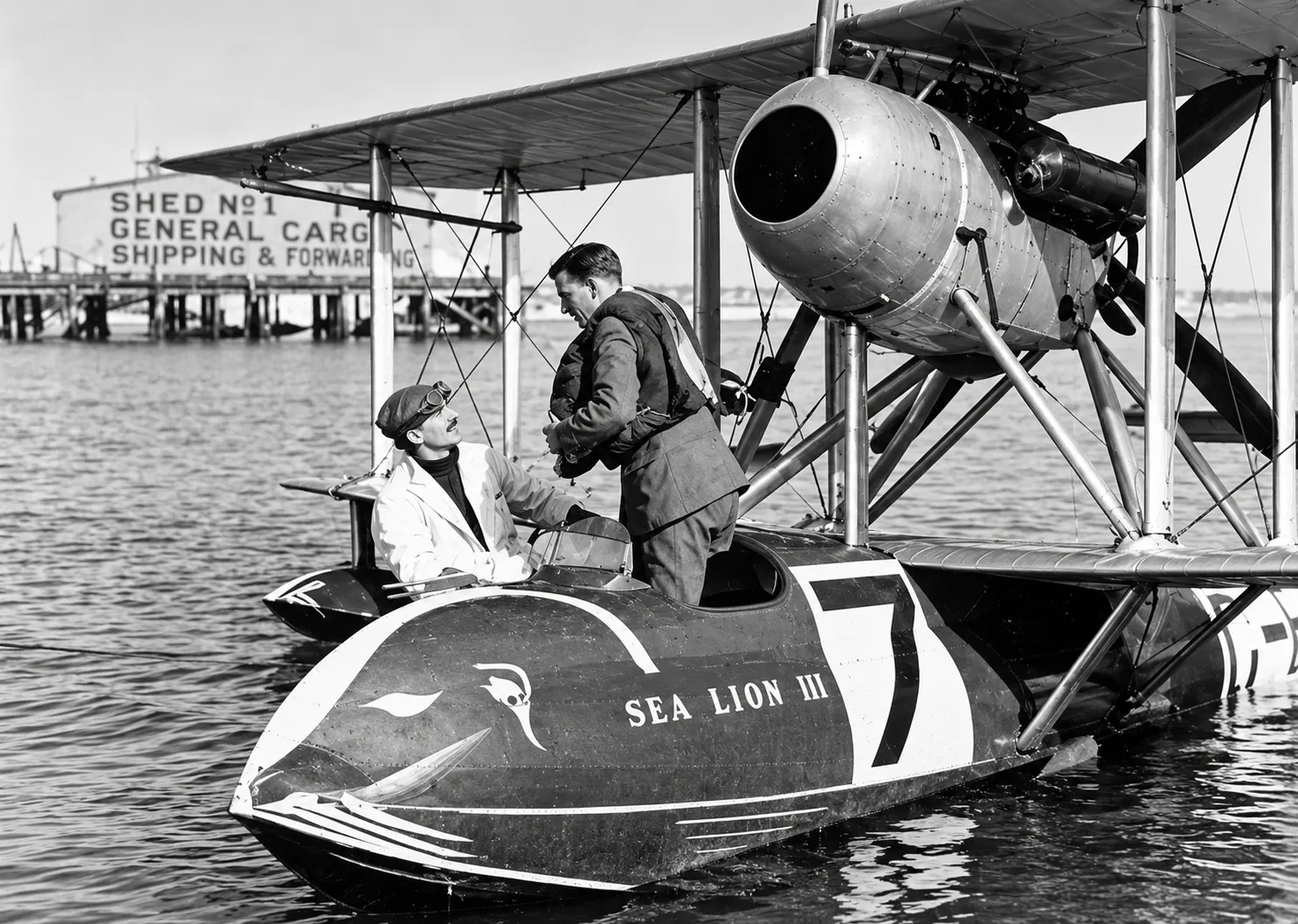
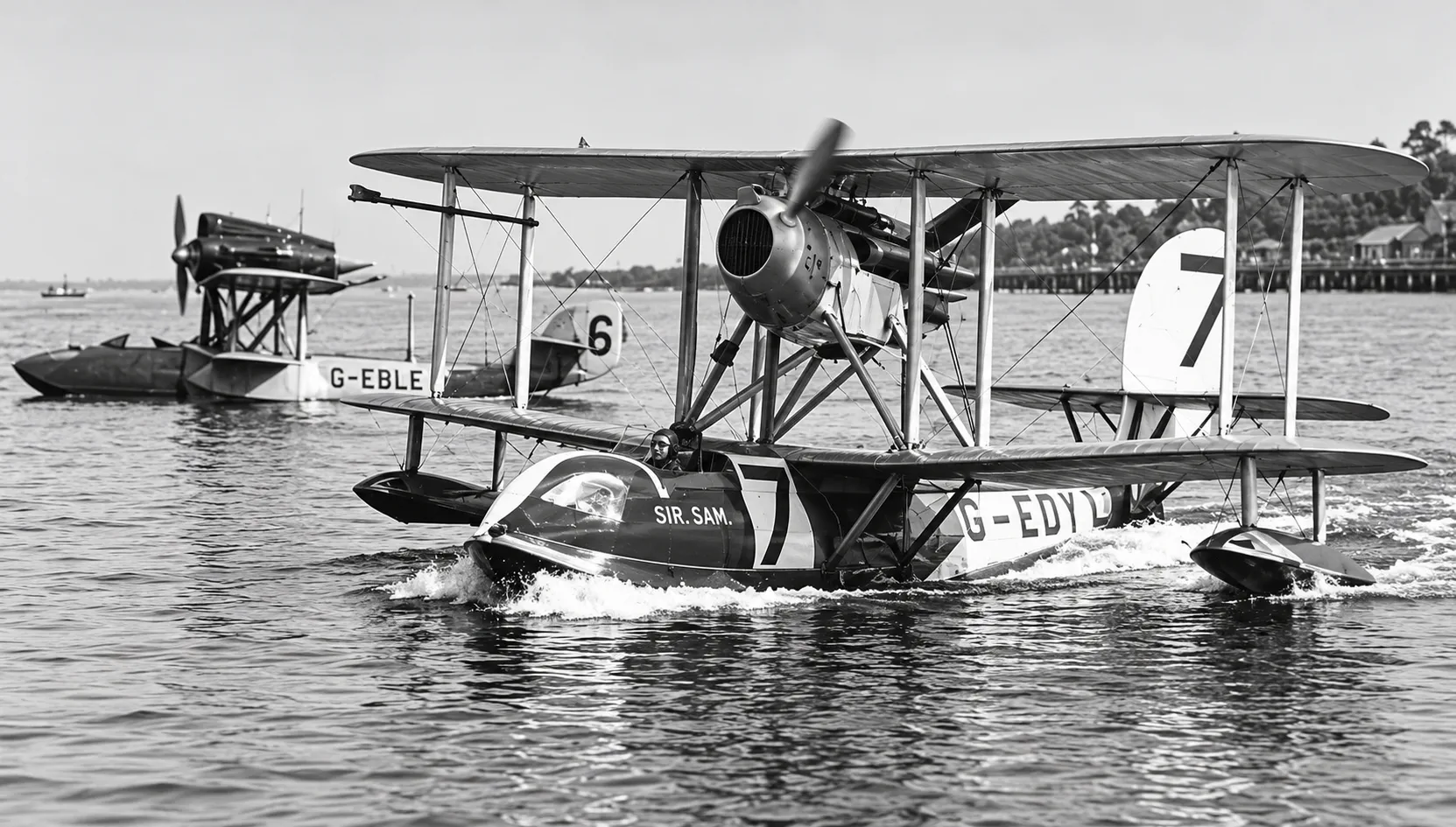
The Supermarine Sea Lion II was a British racing flying boat built by the Supermarine Aviation Works. Designed by Reginald Mitchell, the Sea Lion II was a modification of Supermarine's Sea King II. It was powered by a 450 hp (340 kW) Napier Lion engine.
Entered for the 1922 Schneider Trophy contest at Naples, Sea Lion II was planned to be able to attain a speed of 160 miles per hour (260 km/h). It competed against two Italian aircraft. Supermarine's test pilot Henry Biard flew the aircraft to victory at an average speed of 145.7 mph (234.5 km/h)—the first post-World War I success by a British aeroplane in an international competition.
The Sea Lion II was renamed the Sea Lion III for the 1923 contest, after Mitchell modified the design, and it was re-engined. .



The field and its stakes
The sixth Schneider Trophy contest took place at Naples in August 1922, after wartime interruption and Italian victories in 1920 and 1921. The race is commonly dated 12 August in the near-contemporary U.S. Air Service account, while some listings describe the event period as 10–12 August and one Italian retrospective gives 13 August. The precise day is therefore not uniform across later references; 12 August has the strongest support among the sources compared here. Italy could have secured permanent possession of the trophy with a third consecutive victory. Great Britain entered Captain Henry C. Biard, Supermarine’s test pilot, in the Supermarine Sea Lion II, race number 14, registration G-EBAH. HydroRetro identifies its engine as a 450 hp Napier Lion. Italy’s leading entry was Alessandro Passaleva in the Savoia S.51, race number 8, registration I-BAIU, powered by a 300 hp Hispano-Suiza. The other commonly listed Italian machines were two Macchi M.17 flying boats, flown by Arturo Zanetti (I-BAHG) and Piero Corgnolino (I-BAFV), each listed with a 260 hp Isotta-Fraschini engine. These types and specifications follow the tabulated record at HydroRetro; terminology varies in other accounts, which sometimes call the Macchi entries M.7 or M.7bis.
France had been expected to take part, but a near-contemporary U.S. Air Service report says its two aircraft were not completed in time. It describes the actual contest as a three-aircraft battle between Biard, Zanetti, and Passaleva. Later results records list four pilots, including Corgnolino, and give him fourth place. The most defensible reading is that the later four-place classification includes Corgnolino, while the U.S. report either omits him or reflects an incomplete account; the discrepancy cannot be settled from the sources linked here.
What happened during the race
The race was held over a repeated triangular circuit in the Gulf of Naples. The contemporary U.S. account emphasizes how frequent turns slowed the aircraft, making the result a test of both speed and handling. Biard’s Sea Lion II had a substantial listed power advantage over the Italian aircraft. He completed the race in 1 hour, 34 minutes, 51.6 seconds at a reported average of 145.721 mph (234.516 km/h). Later accounts credit him with a narrow victory over Passaleva. AirRace’s times put the margin at 2 minutes 2.6 seconds, while the U.S. Air Service Newsletter’s Passaleva time makes it only 1 minute 30.4 seconds.
Detailed lap-by-lap incidents are not consistently recorded in the accessible summaries. Avoid treating later narrative descriptions of tactics, engine trouble, or passing order as settled unless tied to a specific contemporary record. The finish order and Biard’s winning time are much more consistently reported than those race-by-race details.
Results and significance
| Place | Pilot | Aircraft / engine as listed | Recorded result |
|---|---|---|---|
| 1 | Henry C. Biard (Great Britain) | Supermarine Sea Lion II; 450 hp Napier Lion | 1:34:51.6; 145.721 mph / 234.516 km/h |
| 2 | Alessandro Passaleva (Italy) | Savoia S.51; 300 hp Hispano-Suiza | AirRace: 1:36:54.2, 142.649 mph; U.S. Air Service: 1:36:22 |
| 3 | Arturo Zanetti (Italy) | Macchi M.17; 260 hp Isotta-Fraschini (HydroRetro) | Listed third; HydroRetro gives 213.63 km/h |
| 4 | Piero Corgnolino (Italy) | Macchi M.17; 260 hp Isotta-Fraschini (HydroRetro) | Listed fourth; HydroRetro gives 199.607 km/h |
Uncertainties in the standings. The winner and winning time are stable across the main results summaries. Passaleva’s elapsed time conflicts: AirRace gives 1:36:54.2, while the near-contemporary U.S. report gives 1:36:22. HydroRetro lists his speed as 230.93 km/h, close to AirRace’s 142.649 mph conversion. The U.S. report instead says the field had three aircraft and identifies Zanetti’s aircraft as a Savoia 19 with a 450 hp Ansaldo San Giorgio engine, and Passaleva’s as a Macchi flying boat with a 300 hp engine. Later specialist results sources list a Savoia S.51 for Passaleva and a Macchi M.17 for Zanetti, while some other summaries reverse or alter model labels. The table follows HydroRetro’s detailed classification but preserves the U.S. account’s conflicting claims above rather than presenting them as reconciled fact.
Biard’s victory kept the trophy in competition and made Great Britain the host for the next contest. Italy therefore did not achieve the third successive win needed to retain it permanently. The Sea Lion II was also the last flying boat to win the Schneider Trophy; subsequent winning designs were floatplanes. For the course geometry and distance disagreements, see the separate course-layout text.
Sources
U.S. Air Service Newsletter, 1922 account (digitized by the U.S. Department of Defense); AirRace, Schneider Cup results; AirRace, historical narrative; HydroRetro, 1922 entrant and results table; Associazione Arma Aeronautica, Italian-language Schneider Cup history.