1926
Location
Race Details
1926 Schneider Cup Course
Venue and shape. The ninth Schneider Trophy contest was held at Hampton Roads, Virginia, on 13 November 1926. The start and finish were at the U.S. Naval Air Station at Hampton Roads (Norfolk). The course was a roughly triangular, closed circuit over Hampton Roads and adjoining Chesapeake Bay waters. A later course account places turning areas in Chesapeake Bay and near Newport News; the broad geography is better supported than exact buoy positions.
Legs and turning points. The three broad sides linked the Naval Air Station/start-finish area, an outer turning point in Chesapeake Bay, and a turn near Newport News. The race was run around seven times. Sources do not provide coordinates or verified leg-by-leg distances, and the buoy/pylon positions cannot be recovered precisely from the material consulted. The map therefore marks the named areas approximately and is not a precise survey. One secondary history describes a “350 km triangular circuit” with 19 bends; other accounts describe a 50 km triangle. The number and meaning of those reported bends are not explained, so they should not be read as a verified 19-pylon chart.
Lap count and total distance. Race histories consistently give seven laps of a 50 km (about 31 mile) circuit, for about 350 km (217.5 statute miles or 189 nautical miles). The 1929 U.S. Air Service retrospective likewise reports seven laps and 188.86 sea miles. Small variations in the mile equivalents reflect rounding and the use of statute versus nautical miles.
How the course was flown. The seaplanes took off from the naval-air-station area, rounded the three-point circuit over water, and finished at the same start/finish zone after the required seven laps. One later account gives the direction as anti-clockwise; the short official/result summaries found here do not state the direction or a turn-by-turn sequence, so the map should not be treated as proof of the precise flown line.
Rules and uncertainty. Schneider rules required an international seaplane contest over water and a minimum distance of 150 nautical miles. The reported 350 km race distance exceeds that requirement. Course length, seven laps, Hampton Roads location, and the general triangle are well supported. Exact buoy/pylon coordinates, exact leg lengths, the relationship between the “19 bends” description and the three-sided route, and the plotted course line remain uncertain. The satellite-style background is illustrative; only the named regional landmarks are historical locators.
Sources: AirRace, “The Ninth Schneider Cup Race”; AirRace, Schneider Trophy results table; U.S. Air Service Newsletter (1929), seven laps and total distance; U.S. Naval Institute Proceedings, “The Navy's Schneider Cup Racers”; Peter C. Smith, The Schneider Trophy Air Races (course direction and landmarks).

The course length and map’s red line is a visual reconstruction, not a claim to the exact historical buoy layout.
The Winner
(800 hp)
246.50 mph

Click the Icons above to be redirected to Wikipedia Information on that subject
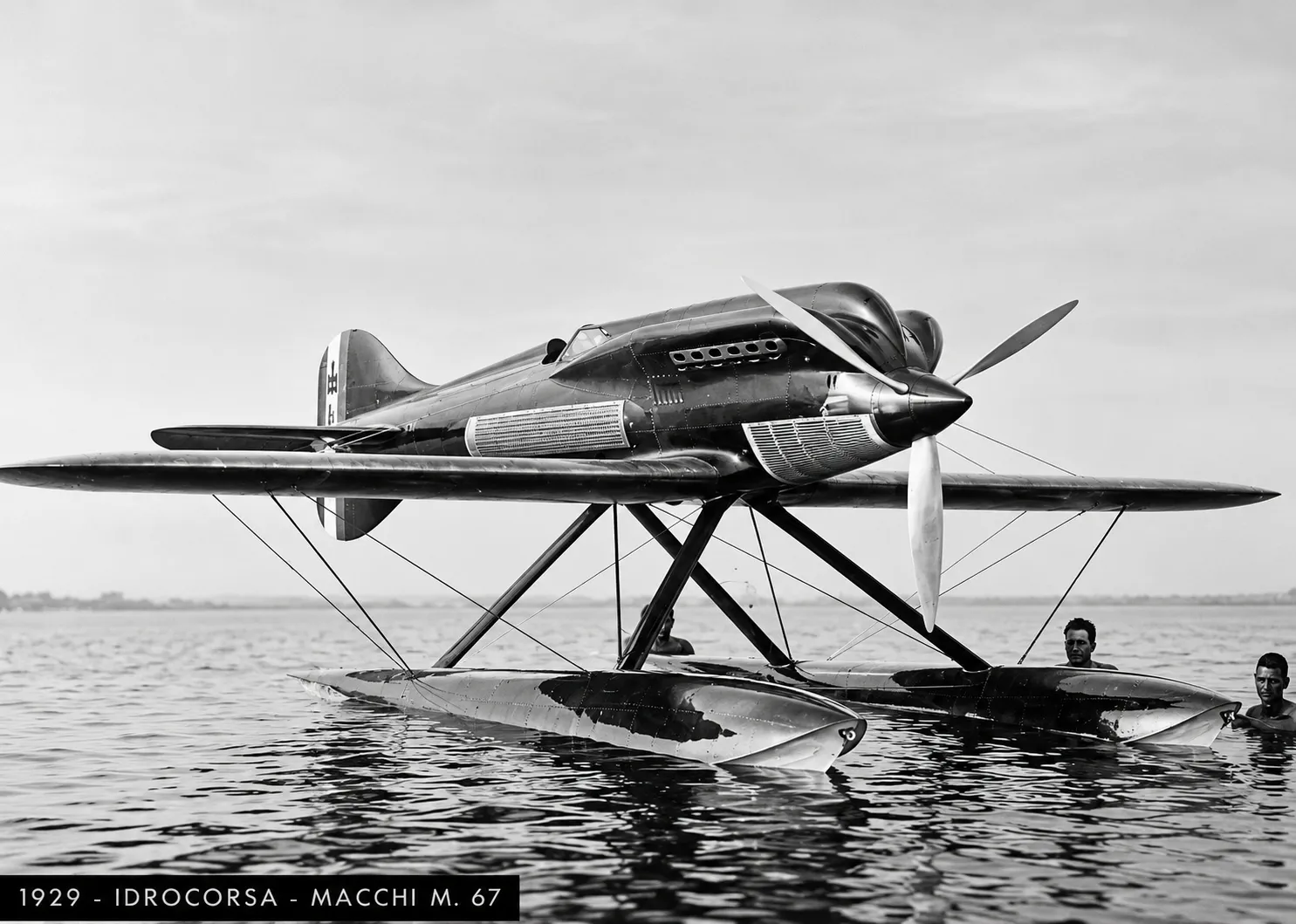
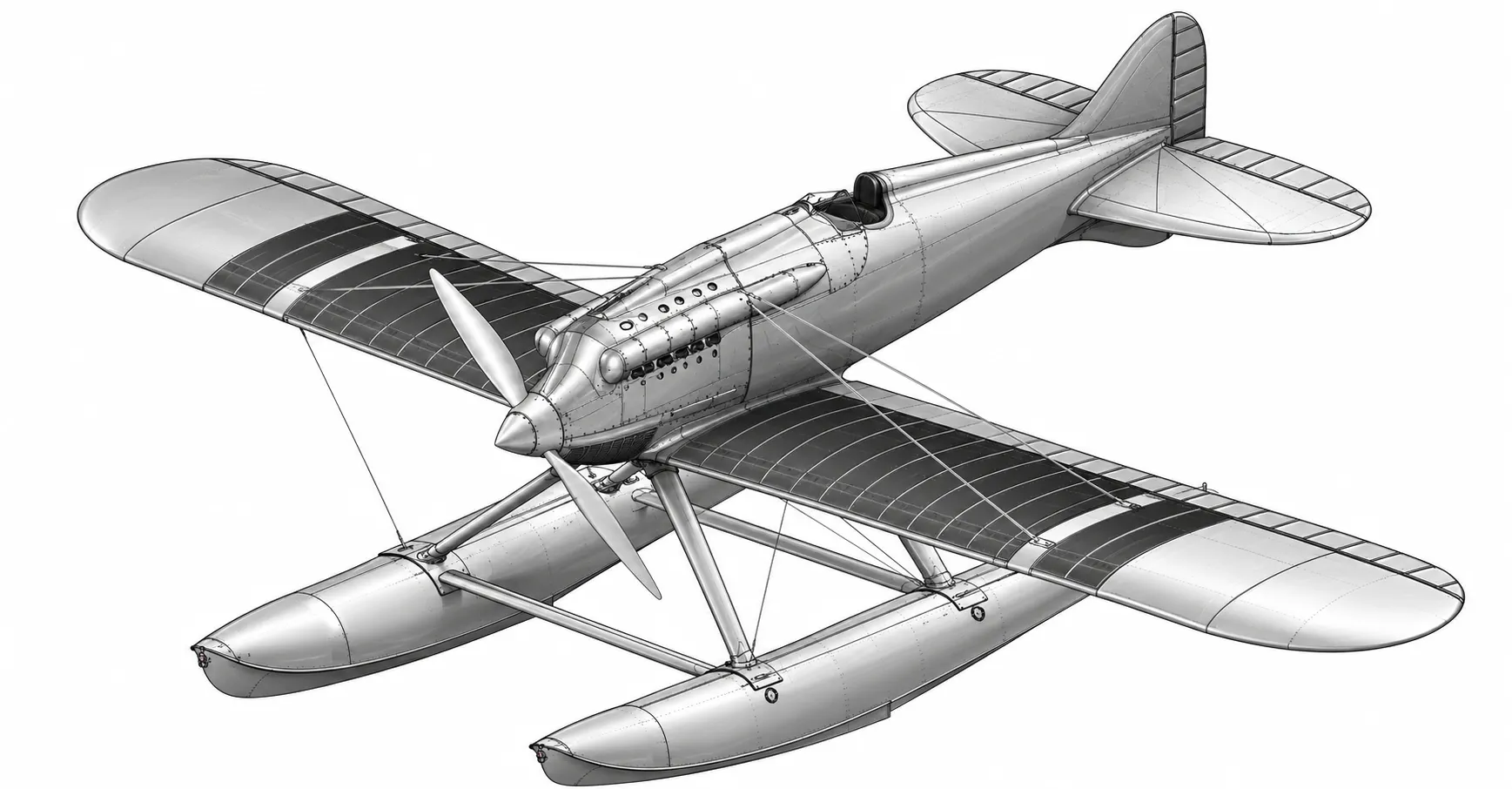
The Macchi M.39 was a racing seaplane designed and built by the Italian aircraft manufacturer Aeronautica Macchi. The type is most remembered for its settings of multiple world speed records during the mid-1920s, as well as for winning the Schneider Trophy, for which the M.39 had been specifically developed.
Designed by Mario Castoldi and constructed in Varese, north-western Lombardy, the M.39 was a considerable departure from the company's preceding racing flying boat, the Macchi M.33. It was a single-seat twin-float seaplane with an open cockpit, tightly-braced monoplane wing, and a streamlined fuselage.






- «
- 1
- 2
- »
Race overview
The ninth Schneider Trophy contest took place at Hampton Roads, Virginia, on 13 November 1926, after a period of weather and preparation delays. It brought the United States and Italy together; Britain and France did not field starters. Six aircraft—three American and three Italian—started the race. Four finished.
Teams, aircraft, and pilots
Italy. Major Mario de Bernardi flew Macchi M.39 MM.76, race number 5; Lieutenant Adriano Bacula flew MM.74, number 1; and Captain Arturo Ferrarin flew MM.75, number 3. The M.39 was Mario Castoldi's low-wing monoplane floatplane design, with twin floats and a liquid-cooled Fiat AS.2 V-12 usually reported at about 800 hp. Its design and engine represented a major step beyond the older American biplane racers. One secondary account differs over whether all three M.39s used the same engine installation, so the exact engine configuration of every individual aircraft is less certain than the type's usual AS.2 specification.
United States. Marine Corps 1st Lt. Christian F. Schilt flew the Curtiss R3C-2 A.7054, number 6—the same aircraft that Jimmy Doolittle had won with the year before, updated with a more powerful engine. Navy Lt. George T. Cuddihy flew the modified Curtiss R3C-4 A.6979, number 4. Navy Lt. William G. Tomlinson flew the reserve Curtiss Hawk floatplane, A.7128, number 2, after the intended Packard-powered R3C-3 was lost in trials. Records variously call Tomlinson's substitute an F6C-1 or F6C-3; result lists and historical summaries do not use a consistent sub-mark.
Absent teams and losses before the start. Britain did not compete: its planned Supermarine S.4 was not ready, and France also had no starter. The American team was badly hit by two deaths before race day. Navy Lt. Harmon J. Norton was killed testing the intended R3C-3; Navy Lt. Frank H. Conant died in a service aircraft crash while flying toward Norfolk. Lt. Schilt replaced Norton, while Tomlinson was selected for the reserve Hawk only on race day. Another R3C-3 was lost during trials; accounts vary on the sequence and timing of the testing accidents.
Race events and results
The contest ran in difficult conditions and the Americans' preparation had been disrupted by aircraft losses, changing assignments, and limited time in the final machines. De Bernardi set the pace in MM.76 and led home the field. Ferrarin retired on the fourth lap with an oil-line/engine problem. Cuddihy retired on the final lap with a fuel-pump failure, reportedly within sight of the finish. Tomlinson brought the substitute Hawk home, but at a much lower average speed than the specialized racers.
Finishing order and recorded averages:
| Place / status | Pilot | Aircraft | Reported time / average speed |
|---|---|---|---|
| 1 | Mario de Bernardi (Italy) | Macchi M.39 MM.76, no. 5 | 52:56.22; 246.496 mph |
| 2 | Christian F. Schilt (USA, USMC) | Curtiss R3C-2 A.7054, no. 6 | 56:23.96; 231.364 mph |
| 3 | Adriano Bacula (Italy) | Macchi M.39 MM.74, no. 1 | 59:51.31; 218.006 mph |
| 4 | William G. Tomlinson (USA, USN) | Curtiss Hawk floatplane A.7128, no. 2 | 1:35:16.72; 136.954 mph |
| Retired, lap 7 | George T. Cuddihy (USA, USN) | Curtiss R3C-4 A.6979, no. 4 | Fuel-pump failure reported |
| Retired, lap 4 | Arturo Ferrarin (Italy) | Macchi M.39 MM.75, no. 3 | Oil-line / engine trouble reported |
Winner and significance
De Bernardi's average of 246.496 mph (396.698 km/h) returned the Trophy to Italy after consecutive American victories in 1923 and 1925. It was then a race record. Four days later, on 17 November, he used MM.76 to set a separate 3 km seaplane speed record of about 416.6 km/h (258.9 mph); that record attempt was not part of the Trophy race. The contest also marked the end of U.S. Navy participation in the Schneider races and highlighted the advantage of purpose-designed monoplane racers and powerful, reliable engines.
Historical uncertainties. Most summaries date the race to 13 November, while event chronologies give a November 12–13 window and one U.S. official patrol chronology lists 11 November, likely reflecting the schedule rather than the race actually run. Winner speed is generally 246.496 mph, though some contemporary newspaper reports print a nearby, different value. The number “19 bends” appears in one specialist history despite the course also being described as triangular; no exact pylon chart in the sources consulted reconciles the wording. Tomlinson's Hawk sub-variant designation also varies by source. The result times and lap retirements below follow the detailed race-result compilation; the broader historical narrative is cross-checked against U.S. Navy and Air Service accounts.
Sources: AirRace, detailed Schneider Trophy results; AirRace, 1926 race summary; U.S. Air Service, “Italy Wins Schneider Cup Race”; U.S. Air Service Newsletter (1929), retrospective results; U.S. Naval Institute Proceedings, “The Navy's Schneider Cup Racers”; U.S. Naval Institute, “The Curtiss Racers”; Planes of Fame Air Museum, Macchi M.39; Naval History and Heritage Command, 1926 Schneider race photograph record.