THE UNTOLD STORY
Written by Mark Blois-Brooke
Venice 1927
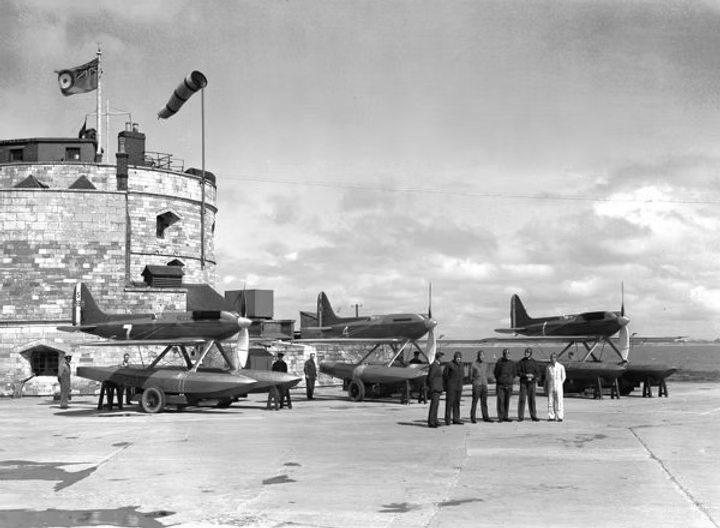
Following their win in the USA , the 1927 race was held on 26th September in Venice. The Italians were in buoyant mood, confident of another victory this time on home territory.They fielded the 1000hp Macchi M.52, an updated, lightened and improved version of theprevious year’s M.39 but engine problems and a fatal accident in practice dampened the Italian pilots’ panache.
In Great Britain, Supermarine were working on an aircraft to meet the Air Ministry’s requirements of 265mph and good handling characteristics. Enter R.J Mitchell’sSup ermarine S.5 monoplane. Powered by a powerful Napier Lion engine with innovative
cooling, this was a true 300 mph thoroughbred that first flew in June of that year. Gloster Aircraft entered the 900hp Gloster IVA/B, that surprisingly retained a biplane configuration, and Short-Bristow the bullet shaped ‘Crusader’. Altogether, five GB aircraft
shipped to Venice for the race; two S.5, two Gloster IVA/Bs and a sole ‘Crusader’ which due to its slower speed was used mostly for practice and later crashed.
The American entry lacked government support. A private venture came to nothing and the US withdrew their participation.
On race day the competition between GB and Italy was fierce. On the 50km triangular course, the Macchis suffered from engine failures and poor piloting while the British Lion engines roared powerfully around the course. The Gloster IVB retired on the sixth lap
leaving the two S.5s, flown by Flt. Lts. Webster and Worsley, to complete the course at 281 and 273mph average speeds respectively. British engineering and flying skills had secured
victory!
Move to Biennial 1928/1929
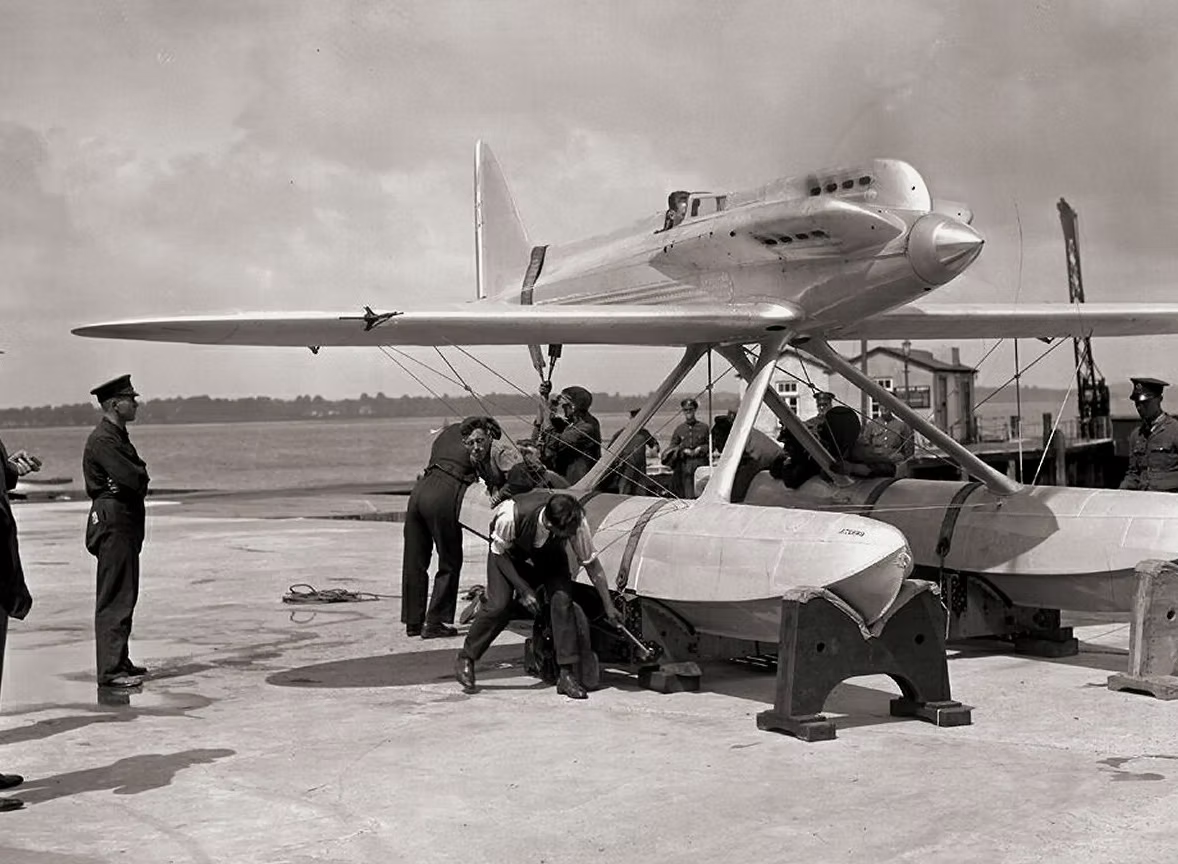
In January 1928, it was decided that the Contest should be a biennial event rather than annual and so it was that the next race was in September 1929 in the Solent. At Supermarine, R.J. Mitchell considered that the Napier Lion engine had reached the end of its development. Rolls-Royce stepped forward with their robust 1500hp ‘R’ engine. This would be mated to the new all-metal S.6 aircraft, two of which were ordered, the first one flying on 10th August. Gloster Aircraft meanwhile was working on the beautiful Gloster VI monoplane but the 1320hp engine was troublesome and prone to cutting out in turns. Gloster eventually
withdrew from the Contest.
In Italy, Macchi, Fiat, Savoia Marchetti and Piaggio-Pegna were all tendering designs. In France, after a six year absence, Bernard and Nieuport-Delage were doing the same. The US
entry, the privately financed Mercury floatplane, turned out to be a non-starter...
Soon however the field thinned out and the final entrants were the new Supermarine S.6 and a S.5 from the 1927 Contest and Macchi with the M.52R and M.67. Weather conditions on
the Solent on 7th September were perfect, sunny with blue skies and a gentle breeze. As the M.52R and the S.5 engaged in a private battle, Flying Officer H.R. Waghorn in the S.6 tussled
with the M.67, the main Italian threat. It was a race of great drama with burst cooling pipes and scalded pilots, smoke filled cockpits and misfiring engines as all the machines were pushed to their limits. Eventually Waghorn prevailed in the S.6 with a phenomenal average
speed around the course of 328.62 mph. One more win and the Trophy was Great Britain’s! However, involvement in the 1931 race hung on a thread as we will see.
Lady Houston Pledge 1931
Incredibly, on the verge of victory, the Royal Air Force decided not to field an entry for the 1931 Contest and instead leave it to private enterprise. Step forward Lady Lucy Houston who
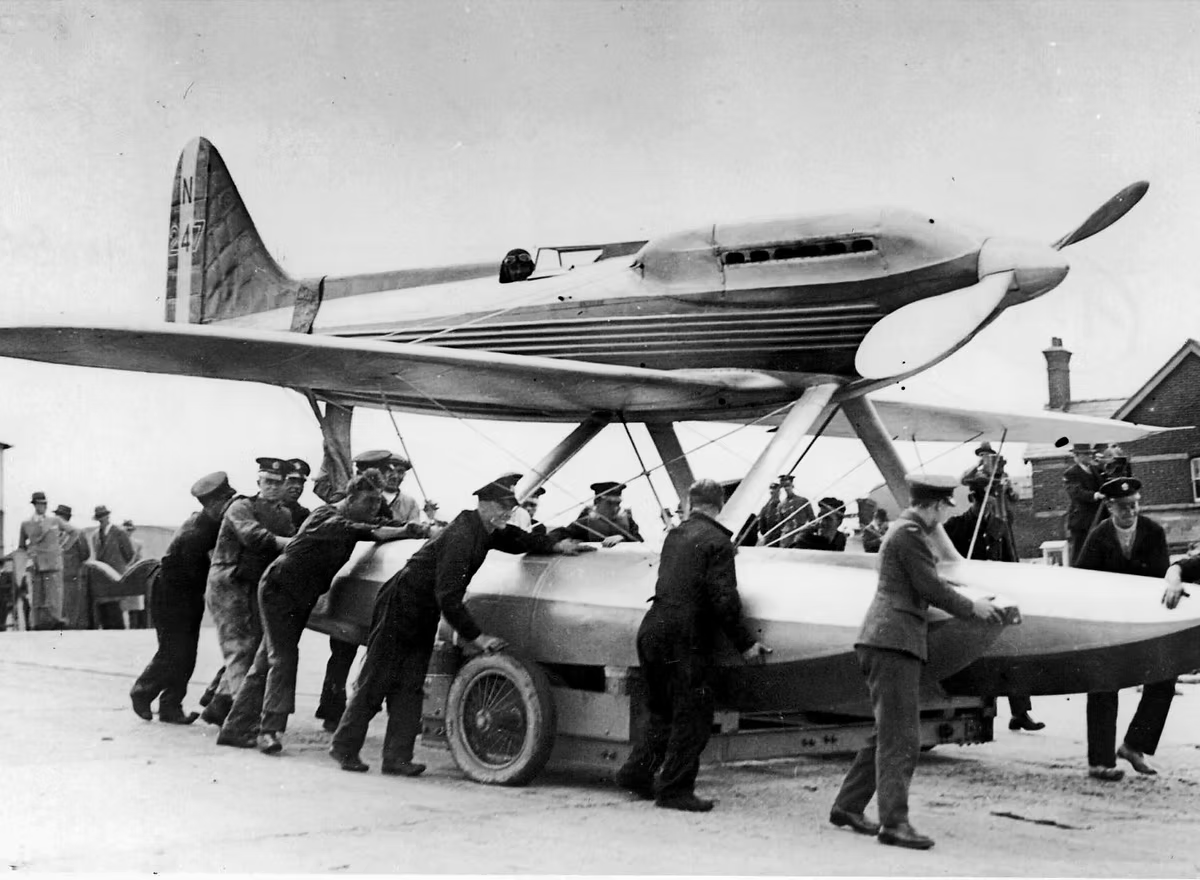
was outraged at this attitude of the Establishment and immediately pledged £100,000 to ensure GB was represented that year, equivalent to nearly £7m in today’s money. In short order, Rolls-Royce worked to increase the ‘R’ Series engine to 2300hp and Mitchell worked to modify the S.6, now the S.6B, to accommodate this extra power and speed.
In Italy, the main threat to GB, Macchi and Fiat were working hard on the MC.72 aircraft powered by a colossal double-length 50 litre 2850hp engine with contra-rotating propellors. France struggled to field an entrant and in the end both nations confirmed that neither would compete this year.
Isle of White 1931
Great Britain now only had to complete the course, that started and finished at Ryde Pier off the Isle of White, to win and retain the trophy. It was essential to be meticulous in planning to prevent an embarrassing disqualification. Thousands of spectators watched the proceedings on the 13th September in ideal conditions. Flt. Lt. Boothman was the first to fly. In spite of engine cooling problems, he completed the course at an average of 340.08 mph.
After 18 years of fierce competition, the Schneider Trophy was finally Great Britain’s! Not content with this, in the same afternoon Wng. Cmdr George Stainforth in the S.6B set an absolute world speed record of 379.05 mph and later in the same month on the 29th and running of a special fuel cocktail smashed this with another world record of 407.5 mph. He thus became the first man in history to exceed 400 mph.
There is no question that Great Britain’s success in the Schneider Trophy with the progressive development of the Supermarine S.4, S.5 and S.6 aircraft lead directly to the legendary Supermarine Spitfire. The experience gained in high-speed flight, powerful supercharged engines and sophisticated cooling was invaluable in the Spitfire development which first flew only four and a half years later.
The rest is history.