Guido Janello

At a glance
Guido Janello (also spelled Jannello or Iannello) did not officially win the 1919 Schneider Trophy. He was the only pilot reported to complete the course, but judges disqualified him for allegedly missing a turning mark. Officials declared the contest void, so it had no official winner. This account covers his disputed finish, not an awarded victory.
Pilot: Guido Jannello, Italian naval aviator and test pilot
Race: Third Schneider Trophy seaplane contest
Date and place: September 10, 1919, at Bournemouth, England
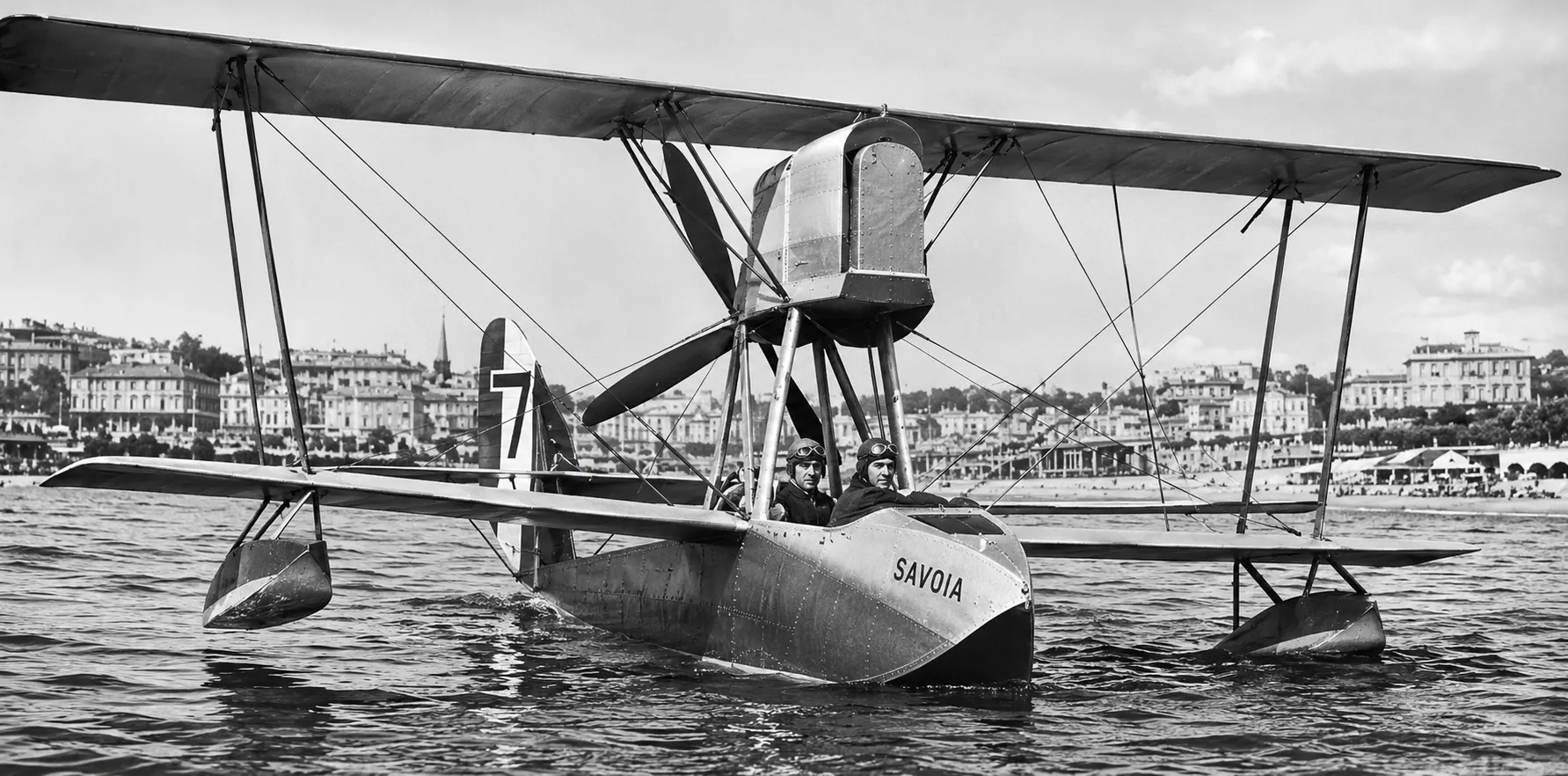
Aircraft: Savoia S.13 flying boat, powered by a 250-horsepower Isotta-Fraschini engine
Result: Reported to have completed the course, but disqualified; the contest was declared void
Why it mattered: The race marked the Trophy’s return after the First World War. Despite the disputed result, Italy was given the right to host the next contest.
Early life
Guido Jannello was born in Santa Margherita, near Messina in Sicily, in 1893. Sources use different spellings of his surname, including Janello and Iannello. An Italian local history says he survived the 1908 Messina earthquake and volunteered for service in the Italo-Turkish War at about 18. Reliable public accounts of his family and education are scarce, so those details are not expanded here. See the local history “Guido Iannello, un grande messinese dimenticato”.
Early flying career
Jannello served in the Italian Navy before moving into aviation. During the First World War he flew seaplanes in the Adriatic, serving in units associated with Federico Martinengo. Later accounts describe him as a decorated combat pilot and credit him with two aerial victories. After the war, he became a test pilot for SIAI, the Italian aircraft manufacturer that built the S.13 he flew at Bournemouth. These biographical details are drawn mainly from the Messina history account; the Italian Air Force’s S.13 history confirms his role as the aircraft’s pilot in the 1919 contest.
The race
The Schneider Trophy was a seaplane speed race intended to encourage development of aircraft that could operate from water. The 1919 contest at Bournemouth was the first after a pause during the First World War. The course was a triangle over the sea, with ten laps of roughly 20 nautical miles each, for a total of about 200 nautical miles (370 kilometres). Race histories differ in their description of the exact course and distance, but identify the Swanage turn as the disputed mark.
Britain, France, and Italy entered. The Italian entry was Jannello in the Savoia S.13, a single-seat development of a reconnaissance flying boat. It had a wooden hull and fabric-covered biplane wings, with its 250-horsepower Isotta-Fraschini engine mounted in a pusher configuration. The Italian Air Force describes the S.13 as a reduced-span, single-seat aircraft developed for the race. See its Savoia S.13 history.
Fog became the central problem. It obscured the distant course marks, and several aircraft struggled before or during the race. The French entries failed to get away, while the British pilots who started did not complete the course. Jannello continued flying and was reported as the sole finisher. The contemporary U.S. Army Air Service later summarized the event by saying that he completed the ten laps, but observers at a turning point said they had not seen him pass. The judges concluded he had not rounded the mark correctly and declared the contest void. See the Air Service Newsletter’s race history.
The dispute centered on whether Jannello had rounded the official Swanage mark. Accounts sympathetic to the Italian team say fog and a non-official boat near the course may have confused the pilot. The judges’ position was that the required mark had not been properly passed. Jannello and the Italian team protested, arguing that visibility and poor course organization made the ruling unreliable. The available sources do not establish independently which boat Jannello saw or exactly what course he flew at the disputed turn. The Kingston Aviation chronology describes the confusion over the Swanage mark-boat and the reserve boat anchored elsewhere.
There are also conflicting accounts of Jannello’s laps after the required distance. One chronology says he landed after eleven laps and was sent out again by his team to ensure he had covered the required distance, after which he did not return before being towed in. Other summaries simply report that he completed the course. Because the contest was annulled and the accounts disagree, this episode should be treated as an uncertain detail rather than a settled part of the official result.
Performance and tactics
The race did not produce an official winner or ratified winning speed. The Italian Air Force’s S.13 history gives Jannello an average of about 204 km/h (roughly 127 mph), but also states that he was disqualified for cutting a pylon. That figure is best treated as a reported performance, not an officially recognized race result. See the Italian Air Force account.
Jannello’s main challenge was navigation in poor visibility. The course required him to identify and round marks over open water while operating a flying boat. A wrong turn or missed mark could invalidate an otherwise fast flight. Since there was no accepted result and no trustworthy official timing, it is not possible to compare his speed precisely with the British or French entries or to claim a verified record.
After the race
The decision to annul the race meant Jannello did not receive an official Trophy victory or prize. As a compromise, Italy was selected to host the next contest, held in Venice in 1920. The U.S. Army Air Service described the venue decision as recognition of Jannello’s effort, while other accounts emphasize that the result itself remained void.
Jannello continued as a SIAI test pilot and was considered for later Schneider Trophy contests, but he did not compete again. Local biographical reporting says he returned to Messina and helped establish the Aero Club of the Strait. He died in Messina on April 9, 1931, after an illness, aged about 38. His later career and death are less thoroughly documented in accessible sources than the 1919 race. See the local biographical account.
Notable facts and legacy
- Jannello is sometimes described informally as the 1919 winner because he was the only reported finisher. Officially, the race was declared void, and no Trophy was awarded that year.
- His Savoia S.13 had a 250-horsepower engine, less power than some British entries, but it was the only aircraft reported to complete the course in the fog.
- The dispute contributed to Italy receiving the right to host the following Schneider contest. The 1920 race took place in Venice.
- The spelling of his name varies across sources: “Guido Jannello” is common in Italian references, while English-language race histories often use “Janello” or “Gianello.”
Sources
- U.S. Army Air Service Newsletter: historical account of the 1919 race and annulled result
- Italian Air Force: Savoia S.13 aircraft history and Jannello’s reported race speed
- Kingston Aviation: race-day chronology and course-mark dispute
- Dorset Aviation Past and Present: Bournemouth race history
- “Guido Iannello, un grande messinese dimenticato”: local biography and military background
- Schneider Trophy History: 1919 entries, disqualification, and no-contest result