The year 1927 stands as one of the most remarkable in aviation history, a period when daring pilots and revolutionary aircraft pushed the boundaries of what was thought possible. From Charles Lindbergh's solo transatlantic flight and the first successful transpacific crossing, to new records for speed, altitude and distance, aviation entered a new era of achievement. Among these milestones was the victory of the Supermarine S.5 in the 1927 Schneider Trophy, a racing seaplane that showcased cutting-edge British engineering and laid foundations for the later development of the iconic Spitfire. As we approach the centenary of these extraordinary accomplishments in 2027, we have the opportunity to celebrate a pivotal year that helped shape the future of flight and inspired generations of aviators and engineers.
First Solo Transatlantic Flight :
Charles Lindbergh flew the Spirit of St. Louis from New York to Paris in 33 hours and 30 minutes on May 20-21, 1927, winning the Orteig Prize.

Charles Lindbergh achieved one of aviation's greatest pioneering feats when he flew the Spirit of St. Louis alone from New York to Paris, covering approximately 3,600 miles in 33 hours and 30 minutes. At a time when long-distance flying was still fraught with danger, Lindbergh faced exhaustion, isolation, uncertain weather, and the vast expanse of the Atlantic Ocean with no modern navigation aids. His successful flight not only earned him the Orteig Prize but also demonstrated the potential of long-range air travel and inspired a new generation of aviators. The courage, determination, and endurance required for the journey made the flight a defining moment of the Golden Age of Aviation and one of the most celebrated achievements in aeronautical history.
First Transpacific Flight :
Lieutenants Maitland and Hegenberger flew 2,407 miles from Oakland, California, to Wheeler Field in Hawaii on June 28-29, 1927, taking 25 hours and 50 minutes.

U.S. Army Air Service lieutenants Lester J. Maitland and Albert F. Hegenberger made aviation history by completing the first successful nonstop flight from the mainland United States to Hawaii. Flying the specially modified Bird of Paradise, an Atlantic-Fokker C-2 aircraft, they travelled approximately 2,407 miles from Oakland, California, to Wheeler Field on Oahu in 25 hours and 50 minutes. Despite navigation challenges and limited radio guidance, the pair successfully crossed the vast Pacific Ocean, demonstrating that long-distance overwater flights were both practical and achievable. Their achievement marked a significant milestone in transpacific aviation and helped pave the way for future international air routes.
Distance Record :
Clarence Chamberlin and Charles Levine set a distance record of 3,911 miles in a Bellanca monoplane on June 6, 192

Aviator Clarence Chamberlin and passenger Charles Levine set a new world distance record when they flew the Bellanca Columbia nonstop from New York to Germany, covering 3,911 miles. The flight took more than 42 hours and surpassed the distance achieved by Charles Lindbergh's famous transatlantic crossing just weeks earlier. Although their original ambition had been to compete for the Orteig Prize, Lindbergh's success came first, prompting Chamberlin and Levine to pursue a record-breaking long-distance flight instead. Their achievement demonstrated the increasing range and reliability of aircraft and helped prove that long-distance international air travel was becoming a practical reality.
Altitude Record :
C.C. Champion reached an altitude of 38,418 feet in a Wright Apache on July 25, 1927

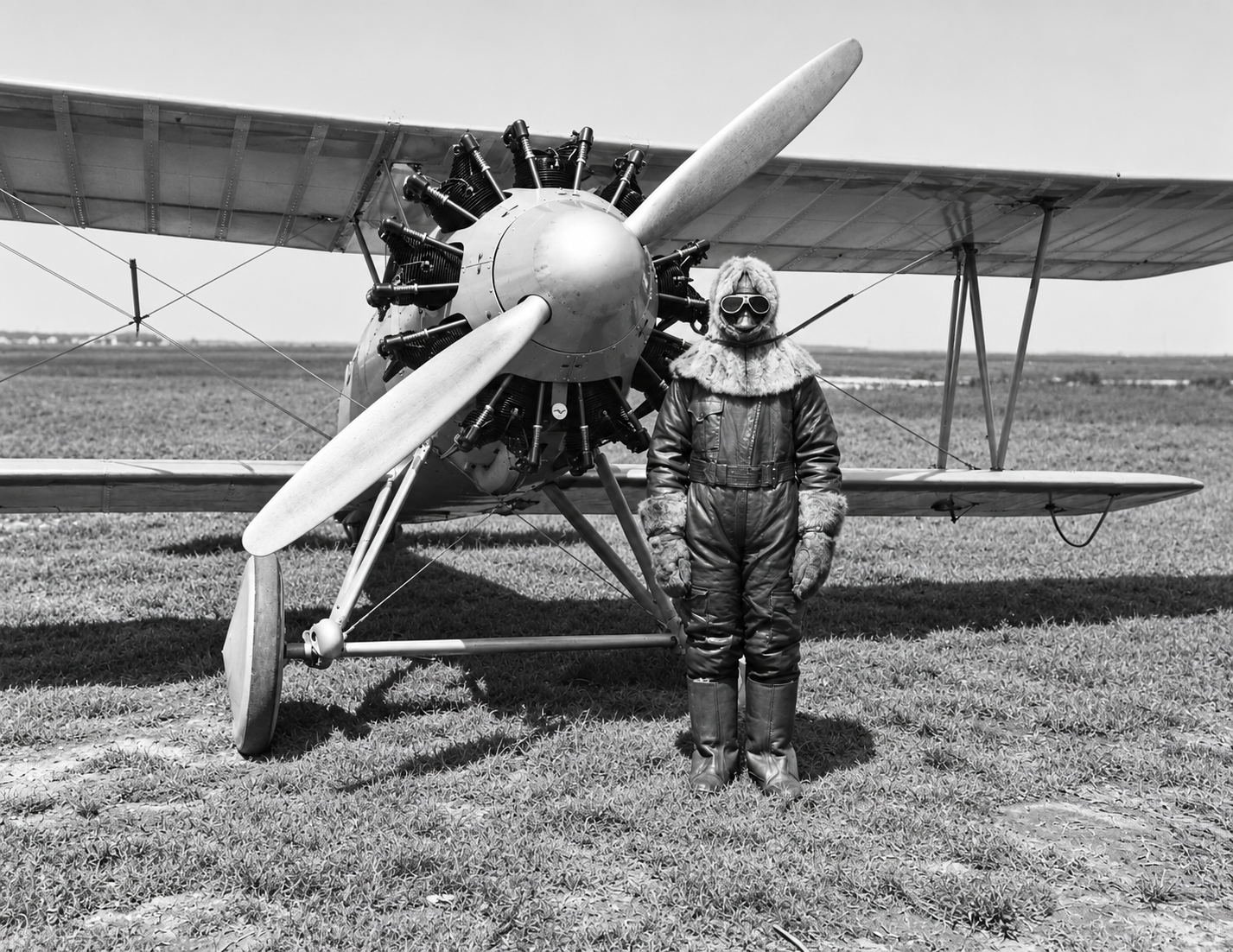
Naval aviator Carleton C. Champion Jr. set a new world altitude record when he climbed to approximately 38,419 feet in a Wright Apache aircraft on 25 July. At a time when high-altitude flying was still in its infancy, the flight pushed both pilot and machine to their limits. The achievement demonstrated the growing importance of high-altitude flight and contributed to advances in aviation oxygen equipment and pilot safety. Champion's remarkable feat stood as a testament to the courage and innovation that characterised the Golden Age of Aviation.
Speed Record :
Mario de Bernardi set a speed record of 297.83 mph (479.29 km/h) flying a Macchi M.52 in Italy on November 4, 1927.

Italian aviator Mario de Bernardi set a new world speed record while flying a Macchi M.52 racing seaplane at Venice. The achievement demonstrated the remarkable advances being made in aircraft design and engine performance during the Golden Age of Aviation. The Macchi M.52 was one of a series of high-speed racing seaplanes developed for the prestigious Schneider Trophy competitions, where nations competed to push the limits of aeronautical technology. de Bernardi's record-breaking flight highlighted Italy's leadership in speed aviation and helped pave the way for even faster aircraft in the years that followed.
First Nonstop South Atlantic Crossing :
Captain Dieudonné Costes and Lieutenant Commander Joseph le Brix crossed the South Atlantic from Senegal to Brazil on October 14-15, 1927.

French aviators Dieudonné Costes and Joseph Le Brix achieved a major milestone in aviation history by completing the first nonstop flight across the South Atlantic Ocean. Flying a specially modified Breguet XIX GR aircraft named Nungesser-Coli, they travelled from Saint-Louis in Senegal to Natal in Brazil, covering approximately 3,380 kilometres (2,100 miles) in just over 18 hours. The achievement demonstrated the growing reliability and range of long-distance aircraft and marked another important step in the development of intercontinental air travel during the Golden Age of Aviation